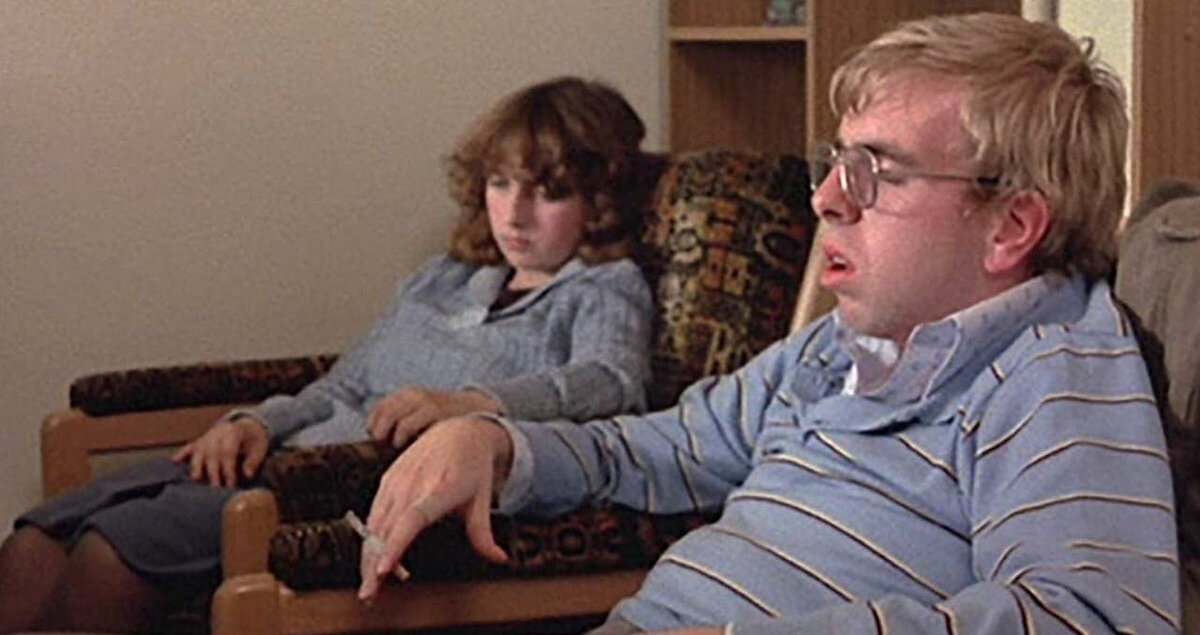
Home Sweet Home (1982), a television film directed by Mike Leigh, part of the BBC’s Play for Today series, is one of Leigh’s bleakest films. In it, the last of his contributions to this series, Leigh portrays the lives and dysfunctional relationships of three postal workers living on a housing estate in Hitchin, Hertfordshire. I’d like to detail what makes Home Sweet Home so drab and claustrophobic – in a way that is distinctly British.
In Leigh’s other films, such as Another Year (2010), bleakness may be confined to a character study. In Another Year, this is shown through Mary (Lesley Manville), who superficially is gregarious and vivacious, but who, deep down, harbours a profound unhappiness; she encapsulates a life in denial, an unresolved midlife crisis, a loneliness that expresses itself through a parasitic dependence on her friends Tom (Jim Broadbent) and Gerri (Ruth Sheen), whose happy marriage starkly contrasts with Mary’s discontent. (The realism of Mary’s character makes it easy to give in to panic about potential or actual singledom in our later years, but we can also contrast Mary’s character with Poppy, played by Sally Hawkins, in Leigh’s 2008 film Happy Go Lucky: Poppy is single but is perfectly content with herself, her career, and the relationships with her friends.)
Leigh’s other films are bleak for similar and different reasons. The aptly named Bleak Moments (1971) shows the loneliness that comes from the struggle to communicate and act on one’s desires; Hard Truths (2024) – Leigh’s most recent film – depicts the noxious effects of unresolved emotional pain; and several other films tackle the issue of class and the socioeconomic roots of misery, including Grown-Ups (1980), Meantime (1983), High Hopes (1989), and All or Nothing (2002). These latter films, excluding All or Nothing, portray bleak aspects of working-class life in Thatcherite Britain, revealing the realities of unemployment, boredom, disaffection, and familial tension. As social realist films, they act as potent critiques of Thatcher’s neoliberal economic policies and the damaging effects they had on the working class. Leigh’s post-Thatcher films, from 1990 onwards, such as Life is Sweet (1990) and Naked (1993), also deal with similar themes.
So why does Home Sweet Home particularly stand out in its bleakness? I think it’s because I don’t recall any glimmers of hope in the film. In the other films mentioned, there are at least characters who feel content (who contrast with the discontent), as well as comedic elements and displays of resilience and human connection.
Naked, widely considered Leigh’s crowning achievement, is often seen as his bleakest work. It is overwhelmingly nihilistic. However, watching Naked (twice) didn’t give me the same feeling as watching Home Sweet Home. I think this is partly because Naked felt more theatrical and stylised in the interactions and dialogue that take place, which is in no way a criticism: when Jonny can’t help but effuse hyper-articulate, cynical, and nihilistic diatribes, we see this as a defence mechanism; it puts him at a distance from others and covers up his own despair, alienation, and self-loathing. Indeed, cynicism is often a learned coping mechanism.
Johnny may resemble people we know, but he acts more like an archetypal character – the pseudo-intellectual, the tortured poet, the anti-hero, the doomsayer, the trickster, the drifter, the misanthrope, the pessimist. He’s not caricaturish like Jeremy (Greg Cutwell), the Patrick Bateman-esque yuppie landlord in the film, but he’s still like a book character (again, this isn’t a criticism; in fact, comparing Johnny to Shakespeare’s Macbeth or Dostoevsky’s Raskolnikov is a sign of high praise).
The (sometimes) theatrical physicality or traits of the characters in Naked don’t stop the film from feeling bleak: the characters are profoundly lonely and desperate, and the female characters suffer at the hands of misogynistic men (including Johnny). But again, watching Naked, to me, felt more like reading depressing fiction than seeing a window into a more realistic picture of British life, which is the impression I got from watching Home Sweet Home. I could imagine the personalities and interactions in Home Sweet Home existing in real life. The realism – the humdrum – weighed me down. (This isn’t to say I therefore value Home Sweet Home more than Naked for this reason; I think the latter is a more interesting creative work in several ways, which is hardly a controversial comparison to make.)
The humdrum in Home Sweet Home consists of endless smoking, tea, biscuits, and inane small talk. It seems all the characters plan and have to look forward to is drinking down at the pub and having a Sunday roast. The film embodies domestic paralysis – the claustrophobia of domesticity and unhappy relationships. Admittedly, I did chuckle at some points in the film, but only because one character, the socially inept Harold (Tim Barker), keeps telling terrible jokes, riddles, and puns. But his harmless jokes are deflated by the context in which they occur; he uses jokes to fill the silence and to avoid any real conversation. His relentless joking also masks the reality of his miserable marriage.
Harold’s wife, June (Su Elliot), escapes the dreary reality of life with Harold by immersing herself in romance novels and, as it turns out, by having an affair with fellow postman Stan (Eric Richard). Harold is oblivious and clueless: when June admits to the affair, he’s unable to grasp why she’s been unhappy and unfaithful. He can’t comprehend what he’s being told; he seems to have the emotional maturity of a child. I’m not surprised June gets so irritated by him.
Stan is a womaniser who compensates for the void left by his wife’s departure by sleeping with his co-workers’ wives. We also see him have a depressing, emotionally detached one-night stand with a woman he meets at the pub. (I’m not sure how he attracts women so easily, given his reserved, dull personality, lack of charisma, and tendency to talk only in monosyllables.) Stan is the epitome of the deadbeat dad. His 14-year-old daughter, Tina (Lorraine Brunning), ended up in foster care at age six because Stan failed to provide a stable home environment for her, after his wife deserted him for another man. He misses planned visits to the home to see Tina, organised by a social worker – the cheery, idealistic, and pushy ‘do-gooder’ Melody (Frances Barber). When we do see Stan and Tina together, their interactions lack genuine affection; Stan is estranged and forcing pleasantries, leading to an awkward atmosphere. Tina appears depressed and detached.
We see a lack of emotional intimacy again in the marriage between Gordon (Timothy Spall, his first collaboration with Leigh) and Hazel (Kay Stonham), the latter of whom desperately seeks affection, not finding it with Gordon, who’s lazy, withdrawn, and unromantic. Her unhappiness leads her to seek the attention of Stan, who seduces her. Hazel berates and complains about Gordon endlessly.
Home Sweet Home is bleak in a more mundane and drab way – depicting the bleakness of British suburbia, the confinement of suburbia – rather than because of anything conceptually or acutely bleak as in Leigh’s other films. The film shows the claustrophobia of doing the same mundane work day in and day out, spending all your time in the living room, or being surrounded by uniform, uninspiring post-war housing. The physical surroundings seem to mirror the emotional stagnation of the characters. The idea contained in the film’s title – the idyllic notion of ‘home sweet home’ – contrasts with the backdrop and lives of the characters. It’s hard to see where the ‘sweetness’ lies. It’s hard to detect any glimmers of hope.
In the ending of the film, this remains true: Stan speaks with a new social worker (Lloyd Peters) – who breaks out into a caricatured, idealistic, leftist monologue – but Stan is detached. He seems irritated and reluctant to meaningfully engage with the system or improve his parenting. The final scene shows Tina wandering aimlessly outside her care home. The ending is deliberately bleak and unresolved. The ending note is one of isolation; Tina lacks a home that feels like home, one that feels secure.
The social worker at the end is an absurd or tragicomic element in the film: we might laugh at his over-the-top nature, his being so out of touch, but there is a tragedy to it too. We come to understand the failures of institutional intervention. There is an absurd but also tragic disconnect between the idealism and pretentiousness of a system intending to help the working class and the failures of that system. This is, therefore, a brief moment where Leigh injects his caricaturing tendency for the sake of social satire and critique. Yet, the first social worker, Melody, is caricatured as well, displaying an exaggerated kind of optimism and cheeriness. The two social workers are portrayed as preachy and patronising – mouthpieces for an out-of-touch middle-class bureaucracy trying to manage or fix the lives of the working class.
The drab humdrum in Home Sweet Home reminded me of some scenes from Peep Show, such as when Mark Corrigan (David Mitchell) says, “Butter the toast. Eat the toast. Shit the toast. God, life’s relentless.” Also, staying with the theme of toast, we find out that Mark’s breakfast consists of brown toast for ‘first course’ and white toast for ‘dessert’. As he puts it, “Brown is savoury, white’s the treat.” It’s these kinds of bland, repetitive pleasures that characterise much of Home Sweet Home and, by extension, British life. June serves Harold baked beans on toast for dinner. There’s no pudding. The film is perhaps Leigh’s bleakest vision of British mundaneness, where life seems to consist of typical British small talk, bickering, complaining, and emotional repression. And the small pleasures barely register as pleasurable to the characters. They’re just a way of ‘going through the motions’.
So, I’d perhaps call Home Sweet Home Leigh’s bleakest film in terms of the stifling feeling it conveyed, although, again, it’s not tragic in the same way his other films are. In an article for Vulture, Chris Feil and Fran Hoepfner write, “Home Sweet Home might be one of the director’s most emotionally frustrating works…Leigh presents the most bummer father-daughter pair…Their fraught, almost-silent relationship demands a catharsis Leigh is unwilling to offer us.”
However, as we’ve seen, the film still sits in the genre of tragicomedy. Feil and Hoepfner rightly place it in this category, not in their list of tragic Leigh films, such as Vera Drake (2004), although I’d question them putting other films in that category, such as Naked and Bleak Moments; Leigh is known for tragicomedy, and most of his films have elements of absurdity and humour. As Leigh said, “All my films are tragicomedies, because life is hilarious and tragic. I don’t make films… where there’s only one way to react. My first film, Bleak Moments, I’ve sat with audiences where you can’t hear a word because they’re laughing all the way through. And I’ve sat with audiences where you think you’re in a morgue.” These different reactions reflect the fact that Leigh’s characters show us the complexity and messiness of life.
In any case, in Home Sweet Home, caricatures and absurdity sometimes shine through to deliver insight into British culture, strained relationships, and a failing bureaucratic system. The film also isn’t bleak for bleak’s sake. The uncomfortable feelings that Home Sweet Home evokes are insightful, too. By reflecting on these feelings, we can question why they’re showing up. What is it about the characters and relationships we find so dreary? What can we learn from them? In the end, we might just be grateful that our lives haven’t turned out like theirs. As one reviewer put it, “[I]n a way you do feel good after watching this story, because you realize that your own problems pale in comparison to what’s just been depicted on screen.”
