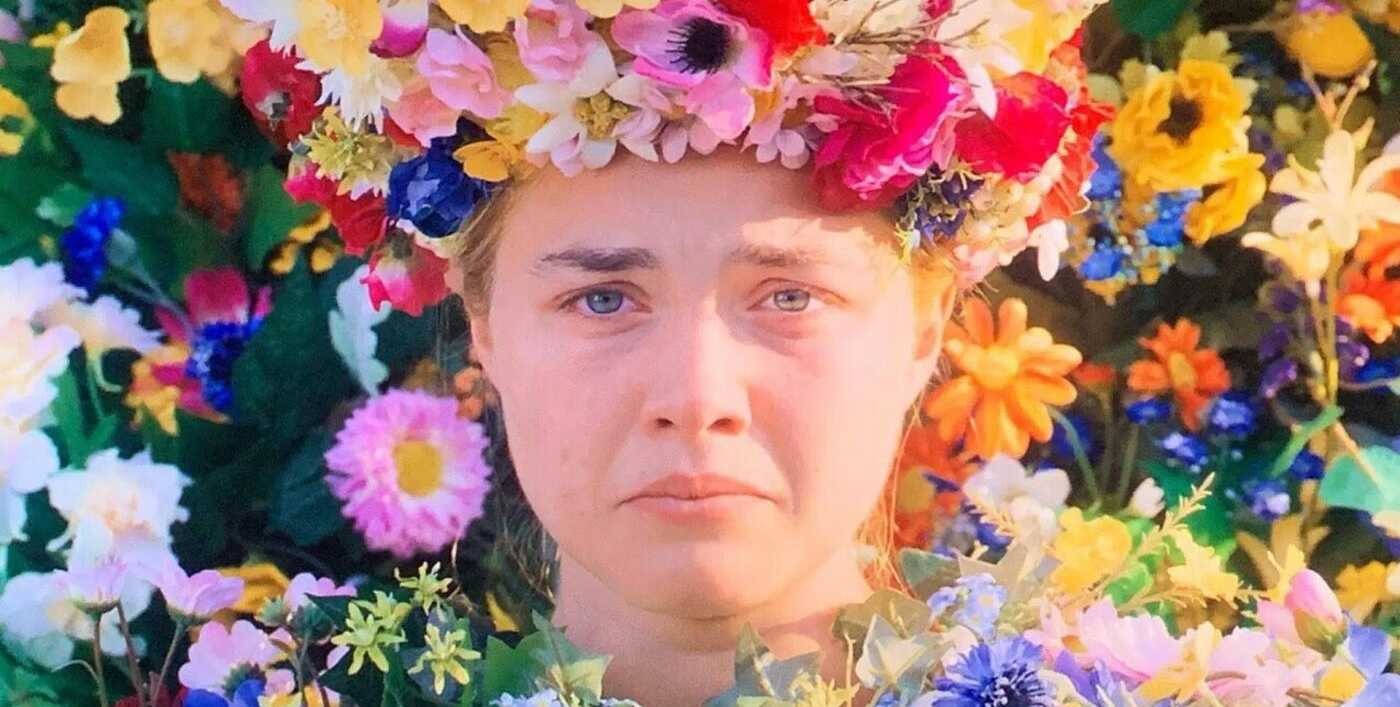
Midsommar (Ari Aster, 2019)
I’m a big fan of horror, as well as the subgenre of ‘psychedelic horror’, in which the psychedelic experience or ‘psychedelic’ aesthetic is used to unsettle and terrify viewers.
I’m also interested in the future of psychedelic horror: What aspects of the psychedelic experience, or what trippy effects, could be realised on screen that have not yet been experimented with? I’d like to take a look at a wide range of films within this genre that might help signify what realms of negative psychedelia could be unearthed – this can also help us to assess what the aim or effects of psychedelic horror are: Is it simply artistic expression? A reflection of widespread fear? Just for thrills? Or might some representations of altered states feed into old stigma surrounding these compounds?
The Bad Trip
The ‘bad trip’ is ripe for psychedelic horror. In whatever form it can take – however the imagination conjures it up – it is the go-to subject of this genre. In one scene from Midsommar (Ari Aster, 2019), for example, we see a group of friends on a psilocybin mushroom trip in a remote village in Sweden, where they’ve travelled for a midsummer festival.
Dani (Florence Pugh), who has recently experienced extreme trauma and loss, and who was hesitant about tripping, starts having a bad trip. As she walks away from her friends to gather herself, she glances over at a group of locals, who she sees turning to her and laughing mockingly: classic psychedelic paranoia. After more disturbing effects, she enters a state of panic and runs off into the woods. In this bad trip sequence, we see the principle of ‘set and setting’ play out: Dani is already in a highly vulnerable mental state; she’s reluctant to trip but is pressured into it; and she’s in an unfamiliar place surrounded by people she doesn’t know. (Besides this, the scene is also one of the more realistic depictions of psychedelic effects.) Midsommar also shows us the potential creepiness of facial distortions on psychedelics, such as when you stare into a mirror.
In an interview for Letterboxd, when asked about the ‘research’ into the psychedelic element of the film, Aster said, “When it comes to the psychedelic stuff, I didn’t really do research. I had taken psychedelics about ten years ago and I had some very bad trips when I was in college.”
Other horror films that depict nightmare trips include Gaspar Noé’s Climax (2018), loosely based on a true story, in which a group of dancers unwittingly drink sangria spiked with LSD. Noé also drew on personal experience:
Having a drug like LSD, knowing you’re taking it, is not always easy. But if someone drugs you against your will it’s a nightmare. It happened to me once late at night when I was really tired. Someone gave me acid and I don’t know whether it was intentional or not, like three drops instead of one. I felt like I was in an altered state, walking along each block seemed like the distance from Paris to Moscow. All my senses were falling apart.
Climax could help serve as a warning about the dangers of unwitting psychedelic use. In the 50s, LSD spiking occurred in the case of the CIA’s covert psychedelic experiments, and the Merry Pranksters in the 60s were giving people LSD without informed consent, which led to distressing experiences and persistent negative effects for some people. Relatedly, in Jacob’s Ladder (Adrian Lyne, 1990), the characters were unknowingly dosed with a hallucinogenic drug by the US Army during the Vietnam War, in an effort to make them more effective in combat. And this is connected to the terrifying hallucinations that they would later experience after they returned home. The film was also inspired by a terror-filled (as well as mystically profound) experience that screenwriter Bruce Joel Rubin had when someone accidentally dosed him with thousands of micrograms of liquid LSD.
Ken Russell’s Altered States (1980), inspired in part by the sensory deprivation tank research of John C. Lilly, follows an obsessive scientist, Dr Eddie Jessup (John Hurt), as he experiments with sensory deprivation and hallucinogenic brews. He experiences startling hallucinations and physically devolves into a pre-hominid creature (this was inspired by Lilly’s documentation of a colleague whose ketamine trip involved them regressing into such a creature). Jessup is obsessed with the idea of discovering his ‘true self’, or base reality of consciousness, which mirrors Lilly’s own aims with his psychonautical explorations, as detailed in his autobiography, The Center of the Cyclone (1972). Altered States, then, perhaps helps to capture the ‘horror’ of obsessive psychedelic use: how plunging the depths of the psyche in search of something ‘ultimate’ can destabilise the self, and reality at large.
Bad trips are also depicted in non-horror films, such as The Trip (Roger Corman, 1967), Easy Rider (Dennis Hopper, 1969), SLC Punk! (1998, James Merendino), Fear and Loathing in Las Vegas (Terry Gilliam, 1998), A Scanner Darkly (Richard Linklater, 2006), and A Field in England (Ben Wheatley, 2013). These films portray the emotional distress, disturbing visual effects, and disorientation that psychedelics can trigger. Some body horror films also show the terrors of mind alteration or technological experimentation, even if not involving psychedelic drugs: examples include Stuart Gordon’s From Beyond (1986) and David Cronenberg’s Videodrome (1983), Naked Lunch (1991), and eXistenZ (1999).
Other films portray psychedelic journeys as a (more common) mixture of negative and positive experiences. Ang Lee’s Taking Woodstock (2009), which has, in my opinion, one of the most realistic trip scenes, shows Elliot Tiber (Demetri Martin) embark on his very first LSD journey: there is initial uneasiness as the effects set in, but with some support and comfort from his fellow trippers, who he’s just met, his experience gives way to joy, ecstasy, playfulness, dancing, and awe.
Another realistic depiction of visionary psychedelic experiences can be found in Jan Kounen’s 2004 film Blueberry (also called Renegade), where we see the ayahuasca visions of Mike Bluberry (Vincent Cassel). These involve disturbing visions of traumatic memories, shifting serpents and spiders, mechanical insects, evil entities, and a violent ‘ego death’ where Blueberry’s physical body is ripped apart. But alongside dark visions are beautiful, luminous geometric patterns. Kounen himself already had extensive experience with ayahuasca in the context of Shipibo shamanism, so his first-hand experience helped to shape the realistic ayahuasca visions we see in the film.
There are many aspects of so-called ‘bad trips’ already depicted in film that could be revisited and experimented with in modern horror, as well as other aspects that haven’t received enough representation. Elements of psychedelia that could work well in horror, I think, include being stuck in a void; time distortion and timelessness; negative DMT entities (such as praying mantis-like or evil jester-type entities); brujeria (sorcery/witchcraft) in Amazonian shamanism, which involves working with evil spirits; terrifying ego death experiences; the varieties of facial distortions; face pareidolia (seeing faces in objects); synaesthesia (the blending of the senses); thought loops; auditory distortions; and delusions. We see the horror of delusions in films like Saint Maud (Rose Glass, 2019). I’m curious what this horror might look like if psychedelicised.
Psychedelic Cults
In Panos Cosmatos’ neon-drenched Mandy (2018), Red Miller (Nicolas Cage) goes on a murderous revenge rampage after consuming a psychedelic drug, given to him by ‘The Chemist’. (It’s probably best not to take psychedelics in a state of rage.) He enacts revenge on a psychedelic cult – called Children of the New Dawn – who drugged and burnt alive Red’s wife, Mandy Bloom (Andrea Riseborough).
Mandy depicts psychedelic facial distortions in a subtly creepy way, but beyond unnerving visual effects, Mandy also brilliantly portrays the dark side of psychedelic cultism. The Manson-esque cult leader Jeremiah Sand (Linus Roache) encapsulates spiritual narcissism and megalomania: he gives long, cryptic, grandiose preachings. He uses his inflated ego – his perception of himself as a saviour – to manipulate others; he’s transformed his delusions of grandeur into control and a loyal cult following. Jeremiah’s fragile ego is ruptured when Mandy laughs at his posturing; enraged by the humiliation, he forces Red to watch as the cult burns her alive.
Mandy can act as a warning about psychedelics getting into the wrong hands, specifically, the hands of fragile, narcissistic egos. Cosmatos said in an interview for Starbust Magazine, “I’ve met someone like him [Jeremiah] many, many times [laughs]. Especially on the west coast of North America, the landscape is teeming with Jeremiah Sands. I’ve been exposed to people like him my whole life so it was really a matter of drawing on all that.” Cosmatos’ directorial debut was the extremely psychedelic horror film Beyond the Black Rainbow (2010), which, like Mandy, was also thematically about control, the cult of personality, and the failed or corrupted search for enlightenment.
In a Substack post, Melanie Boling – an expeditionary research scientist specialising in cluster B personality disorders – described research on how ego death can worsen traits in narcissists and psychopaths. Ego dissolution is not good for everyone. As Boling writes:
The psychedelic renaissance sells a seductive promise: that a single encounter with ego death can accomplish what years of therapy cannot. For many, that promise holds. The neuroscience is genuine. The default mode network falls quiet, rigid self-models loosen their grip, and the brain is granted a rare window in which to reorganize itself.
But that window does not open the same way for everyone, and the field has cultivated almost no literacy around the people it harms. In borderline presentations, dissolution can amplify psychotic features rather than soothe them. In histrionic ones, it lends the performance a spiritual script. In narcissists and psychopaths, it dissolves the defenses while leaving the absence of empathy perfectly intact, returning them to the world with a sharper map of human psychology than the one they arrived with. The same mechanism that deepens compassion in one person refines the predator in another.
She adds that someone with these traits takes psychedelics, they can “become functionally better at what they were already doing, which is manipulating and controlling others.” Boling elaborates:
Ego dissolution loosens rigid self-models and increases the salience of other people’s emotional states, which means that a narcissist or psychopath who goes through this experience emerges with a more flexible understanding of how people think, what they care about, and how to appeal to them. They retain their fundamental lack of genuine empathy, their orientation toward their own interests, and their capacity for instrumental manipulation. But they now have updated maps of human psychology, reframed through a spiritual or healing context, which makes them more persuasive, not less. A narcissist does not become less grandiose after an ego-dissolution experience at altitude. They become more grandiose in a more palatable wrapper: the special person who had a profound spiritual experience and was transformed by it, now here to guide others toward their own transformation. A psychopath does not acquire remorse. They acquire vocabulary. They learn to speak the language of healing, accountability, and community, and they use that language with the same instrumental precision they previously applied to simpler forms of manipulation.
This refinement of predatory qualities could make a cult leader much more effective and harmful. Mandy speaks to this. Psychedelic cults are rich material for psychedelic horror. The subject of cults has been explored in horror films such as Rosemary’s Baby (Roman Polanski, 1968), The Wicker Man (Robin Hardy, 1973), and The Kill List (Ben Wheatley, 2011). But because psychedelics are amplifiers – they can amplify egos, suggestibility, vulnerability, delusions, and cult dynamics – they act as potent catalysts and magnifiers of horror in cult-themed films. This is what makes Midsommar‘s exploration of a psychedelic-infused cult so psychologically rich.
Potential themes or storylines related to psychedelic cults could involve drug spiking, excessive dosing (or insanely high dosing as seen in the Safdie brothers’ 2007 film Good Time), brainwashing, the psychedelicised ego of the cult leader, psychedelic utopianism and evangelism, secrecy and sacrifice, the loss of individual identity and one’s grip on reality (perhaps magnified by depersonalisation and derealisation), cult hierarchy, paranoia about outside forces threatening the cult, and ideas about spiritual warfare.
Does Psychedelic Horror Feed Stigma?
It is worth examining whether psychedelic horror can, or already has, fed into stigma surrounding these substances. Horror films can be seen to reflect and (hopefully) allow us to process personal and collective fears in a healthy way. But some horror films have been critiqued for using lazy tropes that serve to amplify rather than challenge stigma, particularly mental health stigma, where mental illness is generalised, simplified, distorted, and repeatedly associated with violence and murder; it is used to explain away why someone commits an act of extreme violence. Midsommar is guilty of this. However, many modern films offer more thoughtful explorations of mental health, such as Melancholia (Lars von Trier, 2011), The Babadook (Jennifer Kent, 2014), and Hereditary (Ari Aster, 2018).
Psychedelic stigma, much of it inherited from the 60s, might involve fears about psychedelics causing people to jump off buildings, that these experiences are always scary, that they carry a high risk of causing psychosis, that they turn everyone into ‘wacky’ hippies and dropouts, or that they often cause permanent damage in people (examples of ‘acid casualties’ may be cited to support this).
If psychedelic horror shows us the dark side of psychedelics, will this not naturally lead people to come away with negative associations about them, or validate their existing fears? Without evidence to support this claim, I’m not sure how likely the connection is between portrayals of bad trips, say, and negative attitudes towards psychedelics. If someone already has an overly negative perception of psychedelics, then psychedelic horror may just confirm what they already believe. But I think if someone already has a basic understanding of psychedelic effects, benefits, and risks, they’ll be unlikely to treat psychedelic horror as being ‘educational’ about psychedelics, apart from, perhaps, helping to depict altered states of consciousness accurately.
The impact of psychedelic horror also depends on how the psychedelic experience is handled. Many films have depicted bad trips, but this has often been achieved without exploiting tired tropes – like those noted above – which make people afraid to try psychedelics, even under optimal conditions. Of course, there are many films (mostly comedies) that show psychedelic experiences as wild, funny, and surreal – particularly in terms of visual effects. But beyond tropes that psychedelics always cause hallucinations (true hallucinations aren’t that common), can we say that psychedelic horror has helped reinforce any tropes?
Might depictions of psychedelics making people violent, culty, and terrified feed into negative attitudes towards psychedelics, as much as overly positive depictions might validate or exacerbate hype?
Again, this likely depends on how the experiences are represented (although we would need research to find out if certain portrayals of psychedelics can shift people’s views on these substances, to what extent, and if this varies depending on individual differences). In Midsommar, for instance, we don’t have to associate the substance itself with causing Dani’s distress, Mark’s anxiety, or Pelle’s calmness; these experiences depend on factors such as the kind of people they are, their mindset going into the experience, where they are, and who’s around. (Pelle grew up in the commune, and the ritual use of the mushrooms is completely normal for him.) And in Mandy, it would be a stretch to conclude that psychedelics make people culty; rather, people who are narcissistic, lost, or vulnerable can be more susceptible to those dynamics. Using various aspects of set and setting (mindset and environment) as a catalyst for horror, rather than simply the psychedelic itself, is a more responsible, creative, and interesting avenue for psychedelic horror.
While Renegade portrays all kinds of disturbing ayahuasca visions, viewers take these visions to be accurate, so the film isn’t distorting the psychedelic experience. Moreover, some of these visions are beautiful as well, and the disturbing ones are also framed as therapeutic in their own way – as part of the protagonist’s personal healing journey. In the visions, he confronts shadowy creatures, guilt, and the dissolution of self, all of which can be viewed as psychologically valuable, as they often are in real-life psychedelic contexts.
As in the case of mental health representation on screen, including in horror films, the problem is not linking mental illness or psychedelics to horror, but whether or not this is done thoughtfully – in other words, it’s worth discussing the creative and artistic merits (and demerits) of these representations.
Distressing psychedelic experiences are a (potential) reality of experimenting with these substances, just as joyous and illuminating experiences are. As psychedelics continue to be mainstreamed, which has led to more discussion surrounding their risks, this creates a cultural environment in which these experiences can be explored through the genre of horror.
The drama and pitfalls of the wellness industry are shown and satirised in series such as Nine Perfect Strangers and The White Lotus, as well as in the psychological horror film A Cure for Wellness (Gore Verbinski, 2016). The rise of the psychedelic wellness industry – the growth of psychedelic companies, clinics, healing centres, retreats, and ceremonies – could likewise be the basis of new psychedelic horror films. Satirists have already taken aim at modern psychedelic culture, including Dennis Walker, Kyle Lipton, Brent Pella, and Adam Aranovich. I think it’s time for horror to do the same – to use existing trends in psychedelic culture as a vehicle for horror.
The goal is not to demonise psychedelic culture; worthy aims include much-needed satire, critique, an honest engagement with risks, and harm reduction (seeing what factors lead trips to go awry, rather than blaming the substance itself). However, none of this means sacrificing creative freedom and expression: the messages of horror can be stylised and delivered through exaggeration; this is often what horror does best.
These films can communicate that psychedelics deserve respect and precaution, aren’t risk-free, and that altered states can be intense, through exaggeration and artistic license, rather than being as realistic as possible. For example, sound design and body horror could be used to convey the intensity and sometimes overwhelming nature of altered states, even if the specific content is not ‘accurate’. Slasher films don’t lose artistic merit just because they don’t give an accurate portrayal of serial killers. Therefore, demanding that psychedelic films be realistic and have an obligation to serve harm reduction goals would be an unfair standard. Psychedelic horror should be free to experiment – visually, sonically, narratively, theatrically – and this experimentation is valuable independent of realism.
Finally, like all horror films, psychedelic horror can help audiences rehearse, confront, and process fears in a contained way. The genre can allow audiences to process both legitimate and excessive fears related to psychedelics, such as anxiety surrounding losing control, which is a very common worry about the experience. And this rehearsal can be done without taking the substance itself, similar to how horror about death, isolation, or bodily invasion lets people process those fears vicariously through the characters on screen. In this way, psychedelic horror may help us develop a healthier relationship to psychedelics and the anxieties associated with them.

Thanks for this! Didn’t know some of these films. I’m specially curious about
“Beyond the Black Rainbow” (since I loved “Mandy”).
I just saw a nice new one, “Hokum” (https://www.rottentomatoes.com/m/hokum). Much more psychedelic than it appears in the beggining.
Author
I still need to see Hokum. I didn’t realise it had a psychedelic element, so I’m curious to see how that plays out.