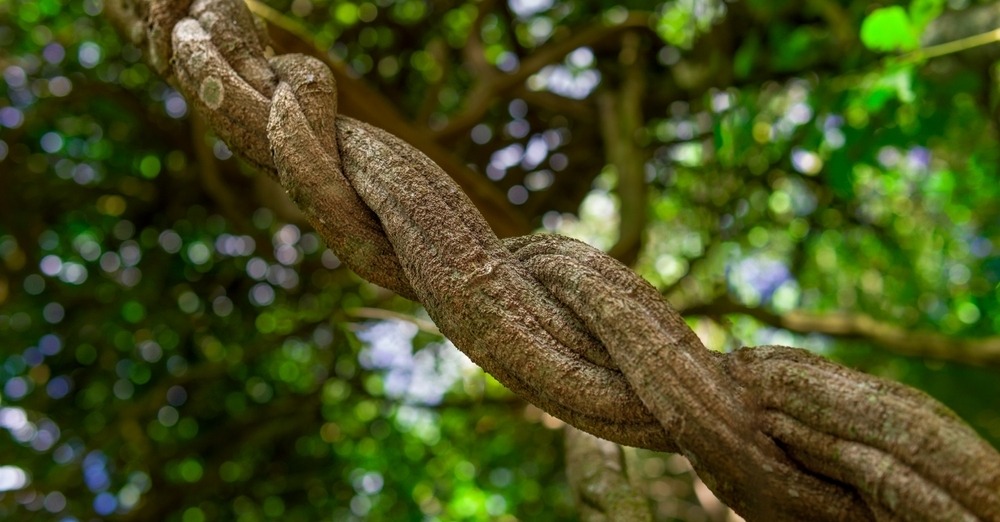
Banisteriopsis caapi: a South American vine used to prepare ayahuasca.
When it comes to the belief in plant spirits, there may be a tendency to exoticise indigenous beliefs and be biased towards them over other religious beliefs one is exposed to or familiar with. This is despite the fact that both types of belief propound supernatural entities. The former belief may seem more trustworthy since it is based on direct, first-hand encounters with purported plant spirits that everyone can experience. Nonetheless, Christians can also speak of a personal experience of Jesus or God, which might occur during prayer (this is a practice that can very well induce altered states of consciousness). If one is willing to look sceptically at one set of claims regarding the supernatural but not another, this may signal an inconsistent epistemic standard.
In the exoticisation of indigenous peoples who traditionally use psychedelics, we may (mistakenly) believe that their lives are perfect, harmonious, and pure, with purposeful psychedelic plants acting as the magic glue holding the community together. But this is often simplistic. It is a narrative that sometimes veers into a desired fantasy of an Avatar-esque world. The British sociologist John Urry developed the notion of the tourist gaze, explicated in his book The Tourist Gaze (1990), which is relevant to this discussion. The term tourist gaze is derived from Michel Foucault’s idea of the medical gaze, referring to the doctor’s tendency to modify a patient’s story, fitting it into a biomedical paradigm, and filtering out the humanising, non-biomedical material.
The ‘gaze’ is an act of selecting what we consider to be relevant and important, ignoring other information because it suits us. Urry applies this idea of the gaze – having a particular way of seeing — to the activity of tourism. He states that “we gaze at what we encounter. And this gaze is as socially organised and systematised as is the gaze of the medic”. As in the case of the medical gaze, the tourist gaze is often about fulfilling the desires of the person doing the gazing.
Tourists who travel to the Amazon basin may, unwittingly, bring a tourist gaze with them. They might want to see psychedelic-using indigenous cultures in a certain way: as idyllic and free from corruptive traits like selfishness, spite, violence, cruelty, misogyny, abusiveness, and dogma. The less palatable aspects of Amazonian shamanism, such as sorcery, are left out of the mainstreaming of ayahuasca in the West.
The result of the tourist gaze, when applied to Amazonian shamanism, can involve an enhanced motivation to take on board the beliefs in plant spirits before, during, or after psychedelic ceremonies. After all, if one links a belief in plant spirits to communal harmony, and one receives lessons after ingesting psychedelic plants, then adopting a belief in plant spirits would appear to make sense. There is also a kind of romanticism to the notion of plant teachers, which can make the belief in them more attractive.
The anthropologist Alice Beck Kehoe argues in Shamans and Religion (2000) that the appropriation of shamanic cultures in neoshamanism and New Age culture misrepresents or dilutes indigenous practices and ends up subtly reinforcing racist ideas. One such idea is the ‘Noble Savage’ trope: the notion of the wild and pure human who has not been corrupted by civilisation and who possesses natural goodness. This way of thinking, which is a form of othering, is also known as romantic primitivism. It is misguided, however, to think that indigenous peoples fit this image, that they are somehow magically untouched and untainted by the global capitalist system.
The cultural anthropologist Evgenia Fotiou writes, “Like other scholars, what I have observed among Western ayahuasca participants is a tendency to reinforce stereotypes. Indigenous peoples are still perceived as close to nature, wise, and spiritual and their traditions, most importantly, are presented as endangered.” This essentialising feeds into an overly positive and fantasised image – a one-dimensional storyline – that indigenous peoples themselves push back against. “It is not true that indigenous peoples are about to die out. We will be around for a long time, fighting for our land, living in this world, and continuing to create our children,” remarks David Kopenawa, a Yanomami shaman and activist.
Fotiou adds that “what many westerners who are looking for guidance or direction from indigenous cultures do not realize is that indigenous peoples do not live in some harmonious state with nature but are people embedded in larger struggles and face important challenges”. The essentialising of indigenous peoples of the Amazon basin – which we could call Amazonianism – can bear a resemblance to Orientalism (a term coined by the Palestinian-American scholar Edward Said to describe the patronising Western attitude towards Middle Eastern, Asian, and North African societies). It is possible for a belief in plant spirits and plant teachers, when framed in a certain way, to fall prey to this kind of romantic primitivism and essentialising.
In spiritual, wellness, and psychedelic circles, this diluted and distorted concept of plant teachers and plant spirits has gained a certain trendiness. Some users might make these terms part of their vernacular, and belief in them part of their identity. But it’s worth examining whether a newly embraced form of spirituality and spiritual identity is being viewed through a particular gaze. Amazonianism is a Western bias that may, ironically, disconnect us from – rather than connect us to – indigenous wisdom traditions.
References
Fotiou, E. (2016). ‘The Globalization of Ayahuasca Shamanism and the Erasure of Indigenous Shamanism’. Anthropology of Consciousness, 27(2), pp. 151–179.
Foucault, M. (1963). The Birth of the Clinic. London: Routledge, 1973.
Kehoe, A.B. (2000). Shamans and Religion: An Anthropological Exploration in Critical Thinking. Longrove, IL: Waveland Press.
Urry, J. (1990). The Tourist Gaze. 2nd ed. London: SAGE Publications, 2002.
This is a slightly modified excerpt from my book Altered Perspectives: Critical Essays on Psychedelic Consciousness (2024, Iff Books).
