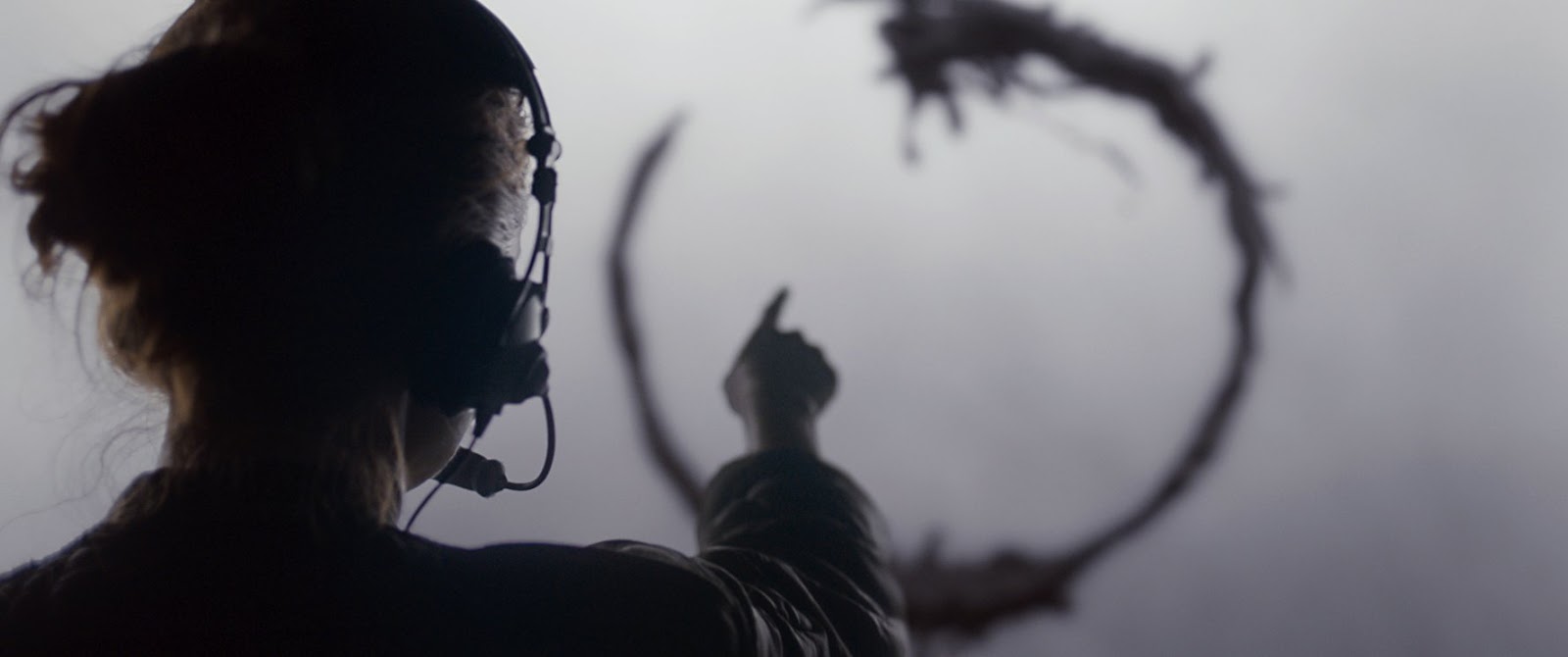
I recently rewatched Arrival (2016, Denis Villeneuve), adapted from Ted Chiang’s novella Story of Your Life, having first watched it five years ago. My experience, based on what I can remember, was different this time around. There were some elements I understood and appreciated more, whereas others somewhat stood out as weak points.
On second watch, I appreciated the cleverness of how the theme of non-linear time was reflected in the non-linear nature of the film’s events (I’m not sure I even remember this tying together when I first watched it). At the start of the film, we see the linguist Louise Banks (Amy Adams) experience flashbacks to time spent with her daughter, as well as her daughter’s life-threatening medical diagnosis, eventual physical decline, and the distress and grief tied to that. And Louise’s morose mood at the beginning further gives us the impression that she’s still carrying around this heavy grief.
When Louise interacts with the aliens – the Heptapods – she experiences what appear to be flashbacks of her spending time with a child, Hannah, whom she doesn’t recognise at first. As it turns out, these are not flashbacks but flashforwards: seeing into her future life and the child she will eventually have. Cinematically, they are portrayed as memories of the past – deliberately crafted to look and feel like flashbacks – but it turns out they are visions of Louise’s future. The non-linear nature of the film’s storytelling is that the beginning of the film, where we also see ‘flashbacks’, is the end: these are also flashforwards. The emotional scenes of Hannah growing up and dying are in the future, not the past. (In one scene, Louise tells Hannah her name is a palindrome, as it’s spelled the same forwards and backwards, and, likewise, the film’s narrative structure can be viewed as palindromic.)
The story is non-linear, like a circle, where the end connects to the beginning. And this reflects the non-linear nature of the Heptapods’ language (where semantic meaning is expressed in varying circle-like patterns that they emit), as well as their perception of time, where they perceive the past, present, and future at once. This is the ‘gift’ – which originally Louise translates as ‘weapon’ – that the Heptapods give to her, which they want humanity to use. It is the gift of learning their language, which allows humans to perceive time as the Heptapods do.
The idea is that learning the Heptapod’s non-linear language rewires the human brain to perceive reality (i.e. time) differently (again, non-linearly), which is another fascinating, mind-bending aspect of Arrival. This theme is hinted at with the early mention of the Sapir-Whorf hypothesis, also known as the linguistic relativity hypothesis, developed by the American linguists Edward Sapir and Benjamin Lee Whorf. It proposes that the language one speaks shapes how one thinks and perceives reality. And there are weak and strong forms of this hypothesis.
There is some evidence for the Sapir-Whorf hypothesis – at least the weak version, which states that our native language influences how we think and perceive (i.e. linguistic relativity), rather than determines this (i.e. linguistic determinism). But the theory has also been widely critiqued (see here and here). Almost all linguists reject linguistic determinism – the view that a person’s thoughts and perceptions are limited by their language – whereas linguistic relativity makes and validates much more modest claims: linguistic terms for colours, for example, can lead to measurable differences in cognition. But this doesn’t entail permanent alterations to perceptions of reality. And most studies attempting to test the hypothesis have focused on colour, which is just one aspect of cognition and perception.
The version of the Sapir-Whorf hypothesis that underlies the basis of Arrival is the strong version – linguistic determinism – the version that has long been rejected. Linguistic determinism reminds me of the ontological turn in anthropology, a view which proposes that different cultures don’t have different worldviews; rather, they inhabit, quite literally, different worlds. The similarity between linguistic determinism and the ontological turn also comes through in the film, where a connection is made between the Chinese game of Mahjong, which China tries to teach the Heptapods: this is perceived as dangerous, as it’s a game that categorises players in terms of winners and losers, and so this kind of language could, supposedly, inculcate the aliens with a competitive view of reality.
Betty Birner, a professor of linguistics and cognitive science at Northern Illinois University, told Slate, “It was a ton of fun to see a movie that’s basically all about the Sapir-Whorf hypothesis. On the other hand, they took the hypothesis way beyond anything that is plausible.” Indeed, Arrival takes us beyond the strong claim of linguistic determinism, and not just because of claims about alien languages. As Birner states:
At one point in the movie, the character Ian [Jeremy Renner] says, “The Sapir-Whorf hypothesis says that if you immerse yourself in another language, you can rewire your brain.” And that made me laugh out loud, because Whorf never said anything about rewiring your brain. But since this wasn’t the linguist speaking, it’s fine that another character is misunderstanding the Sapir-Whorf.
Although this is still the basis of the film. In a sci-fi film, it’s an interesting idea – that a human learning the language of an alien being can perceive past, present, and future simultaneously, by rewiring the brain through language. Birner writes:
No linguist would ever buy into the notion that the minute you understand something about this second language, get sort of a lightbulb going off, and you say, “Oh my gosh, I completely see how the speakers of Swahili view plant life now.” It’s just silly and its false. It makes for a rollicking good story, but I would never want somebody to come away from a movie like this with the notion that that’s actually a power that language can bestow.
But she still had reasons to praise the film from a linguist’s perspective:
Whorf argued that because the Hopi [the Native American group he was studying] have verbs for certain concepts that English speakers use nouns for, such as, thunder, lightning, storm, noise, that the speakers view those things as events in a way that we don’t. We view lightning, thunder, and storms as things. He argued that we objectify time, that because we talk about hours and minutes and days as things that you can count or save or spend.
It was funny in this movie to see this notion of the cyclicity of time. That’s really central in Whorf’s writings, that English speakers have a linear view of time, and it’s made up in individually packaged objects, days, hours, and minutes that march along from past to future, while the Hopi have a more cyclical notion that days aren’t separate things but that “day” is something that comes and goes.
So tomorrow isn’t another day. Tomorrow is day returning. You see that concept coming from Whorf into this movie was actually kind of fun. I thought, well they got that right!
She adds how she appreciated the portrayal of the alien logograms, which are genuinely meaningful, even though they lack a particular word order:
I actually loved the logograms, because I am one of the many people who can get cranky about sci-fi in general, because the aliens are always so closely based on human beings and alien languages are just another variation on human languages. They don’t look anything like Kanji or any other written language that I know of. So to see something that was really, really different but plausible as a communicative system was terrific.
It was a nice touch that the circularity of the image mapped onto the cyclicity of their worldview. The past, the future, it’s all just one big cycle that they can see from outside. It would sort of make sense that there’s no need for word order, that there should be this holistic aspect to a sentence in such a world where there’s really no linearity to time. I thought [the filmmakers] put some real thought into making it be not just be a clone of a human language, even though, yeah, you had to give up the word-order issue which is my whole research area. Oh well.
The strong version of the Sapir-Whorf hypothesis that underlies Arrival (although distorted and made sci-fi) is intriguing – if you can suspend disbelief and don’t feel a need for its mechanism to be explained, i.e. how learning an alien language rewires the brain and changes one’s perception of time. But if you start questioning the idea, it does seem to veer into kind of wacky Terence McKenna territory. (This is not necessarily a weak point; it depends on what you want from sci-fi, and how much you want it to be explained, explainable, or plausible.)
When McKenna smoked DMT, he encountered elfin entities who he said were made out of “syntax driving light”, and that he wasn’t sure “why there should be an invisible syntactical intelligence giving language lessons in hyperspace.” (Could this be the psychedelic version of Arrival?) These ‘self-transforming machine elves’ communicated using a visible language, in which thoughts turned into visible objects. McKenna described these entities singing objects into existence. These DMT experiences would influence his view of reality, which he believed was structured by syntax: “The syntactical nature of reality, the real secret of magic, is that the world is made of words. And if you know the words that the world is made of, you can make of it whatever you wish.”
In short, I enjoyed the theme of non-linearity in Arrival and its reflection in the narrative structure, even if it didn’t draw on linguistics accurately (which I assumed the film did, at least with respect to the alien logograms). The Max Richter score and cinematography are impressive, too: both suffuse the scenes and atmosphere with mystery, vastness, and momentousness. That said, I had the feeling that the score was, at times, manipulating an intended reaction rather than this reaction being organic.
Relatedly, one of the main weaknesses of the film, for me, was that a certain emotional reaction was expected – in relation to Louise’s narrative arc – but it rubbed the wrong way at times. In a sense, the film felt more like a glorification of self-importance than an inspiring Hero’s Journey: the biggest event in human history, and the future of humanity, centred around one woman and her life. The aliens were motivated to warn just one woman about tragedy in her future.
With a more charitable interpretation in mind, the aliens likely knew to focus on Louise because she was a respected linguist, and, as we see in one of her flashforwards, she will eventually teach others about the Heptapods’ language, thereby spreading the ‘gift’ around. The title of her future book is The Universal Language, as the Heptapods’ language is for all of humanity; it goes beyond the limits of human languages, which shape our cognition and reality in varying ways; it is a language that takes us beyond these differences and limitations, and enables the universal experience of time, in which past, present, and future are experienced at once. This transcendent (alien) source of universal language is presented as the salve for our conflict and warring.
As much as I loved Max Richter’s score in Arrival, what didn’t resonate with me was when it was being used to dial in the deep, cosmic poetry of Louise’s life and all her realisations. Don’t get me wrong, her musings about amor fati – her newfound belief that it’s worth going through with the life she foresees for herself, despite her daughter’s illness – are worth reflecting on. It was Malick-esque, owing to this contemplative tone. But it didn’t quite land for me. It came across as contrived and saccharine, and the idea of making Louise’s emotional resolution and embrace of her future the conclusion of the film was less interesting to me than the grander, more novel explorations of alien contact, alien linguistics, and time. Although arguably, the alien visitation and contact is just the backdrop, the ‘Trojan horse’ that helps deliver Louise’s emotional journey, which is really the core of the film. So Arrival’s marriage of sci-fi with emotional storytelling doesn’t have to be seen as incongruous; for many viewers, it does this well, and it’s what makes it such a unique sci-fi film. And many other sci-fi films have done the same, also successfully, such as Interstellar (2014).
To offer some philosophical analysis of Louise’s flashforwards, it’s worth thinking about whether being granted the Heptapods’ ability to see into the future makes sense. Of course, the future that one sees is real, so long as one doesn’t do anything to disrupt the chain of events, of cause and effect, that materialise those future outcomes. But, say Louise didn’t accept the future she foresaw; she could’ve avoided having a child with her future partner, Ian. In which case, were her premonitions about only possible scenarios, rather than actualised ones? If so, this would conflict with the idea that her new perception of time, shared by the Heptapods, is an experience of all actual events.
The notion of premonition conflicts with free will: if what we foresee will inevitably unfold, then we can do nothing to avoid it. We can imagine this is untrue in Louise’s case, unless we assume she has no agency to make different life decisions and procreative choices. On the other hand, the film may be suggesting that the future is, indeed, determined, thus making free will an illusion. The only agency Louise has is in her attitude towards her fate: she can either adopt the attitude of amor fati, embracing and loving her future life, or decide not to.
The portrayal of the emotional impact of the aliens’ arrival was mixed, with some of it appearing realistic and other parts not so much. The term ‘ontological shock’ is used to refer to an experience that shatters one’s worldview, resulting in overwhelm, confusion, or destabilisation. Alien contact is considered a candidate for triggering ontological shock. But this ‘shock’ didn’t seem to come through when Louise learned of the aliens’ arrival or heard their language for the first time. The only time we see the overwhelming nature of it all is when someone gets carted off by medical personnel at the military base because they couldn’t handle the magnitude of the situation. It could also be argued that the social upheaval shown in the film was a realistic expression of this shock.
What was handled really well, and the most engaging aspect of the film for me, was contact with the aliens – how uncertain and unnerving it was, where it’s not clear what’s safe, what their intentions are, what they’re like, or how advanced they are. As a portrayal of first contact, of being humbled and curious about an alien craft and alien species, Arrival is unique. Alongside this is a refreshing, novel, and creative depiction of what alien beings might look like. Arrival avoids all the usual tropes, such as malicious invaders and humanoid beings, and instead presents us with a species, language, and form of technology that feels truly alien.

I always love your analysis of movies. This one is special, because it’s one of my favourites. But for me, the personal journey of Louise was as strong as the contact. She basically come to terms with the whole of life, including grief and tragedy. Even knowing beforehand that it will be terrible she dives in, because this terribleness and all the immense suffering is inseparable from the preciousness and from love.
I agree with you that the music adds too much sugar, but her lived insight is enourmous. Sometimes people realize this at the end of life, but she already has the memories of the future, and exactly for understanding this wholeness, she accepts.
I think that the plot implies no free will, otherwise it would contradict the premises, as you pointed out. But this creates an even bigger acceptance — this is quite something, maybe better than contact.
Author
Thanks, I appreciate the kind words.
I definitely get why Louise’s personal journey is as strong, if not more strong, than the alien contact aspect. I think I went into the second viewing just wanting a really great alien contact movie, and I had less memory of the emotional journey Louise went through and its central role in the film. I think, at least in the mindset I was in at the time, some of the ‘poetry’ of it, or the tone of it, didn’t quite land. So I would definitely watch it again, and I’m sure it would be a different experience again the third time round, because I am really interested in this idea of embracing your life exactly as it is, if you knew it would unfold that way from the beginning.
The Ted Chian novella has a different vibe, the emotional side is kind of compartmentalized. There are two stories being told in a separated way, alternating sections. But slowly they start to merge, and in the end becomes the same in a very potent narrative effect, reflected in the title “Story of Your Life”. I think Dennis Villeneuve chose to do this in a different way, awesome too.
Author
I read Chiang’s novella a while ago, so I can’t remember too well how it differs from the film, but the difference in narrative structure you mention is interesting. I’d also be curious to re-read it.
Linguists rejecting linguistic determinism seems hollow to me. Of course they do not accept their science is determined by the subject studied. Otoh it seems impossible to prove either side, how would science without language even work?
Author
You’re right to point out that science without language wouldn’t work, but I imagine most linguists would acknowledge that as consistent with linguistic relativity, rather than that implying linguistic determinism (in the sense they use it).
I suppose the weaker position of linguistic relativity would say that language can influence science – how things are categorised, or the abstract concepts or terminology scientists use – whereas linguistic determinism would say the language someone speaks determines or limits how they think about or does science.
I haven’t been able to find any mainstream linguists defending linguistic determinism, but I’d be curious if there are any, and what they have to say about it and why they reject linguistic relativity.